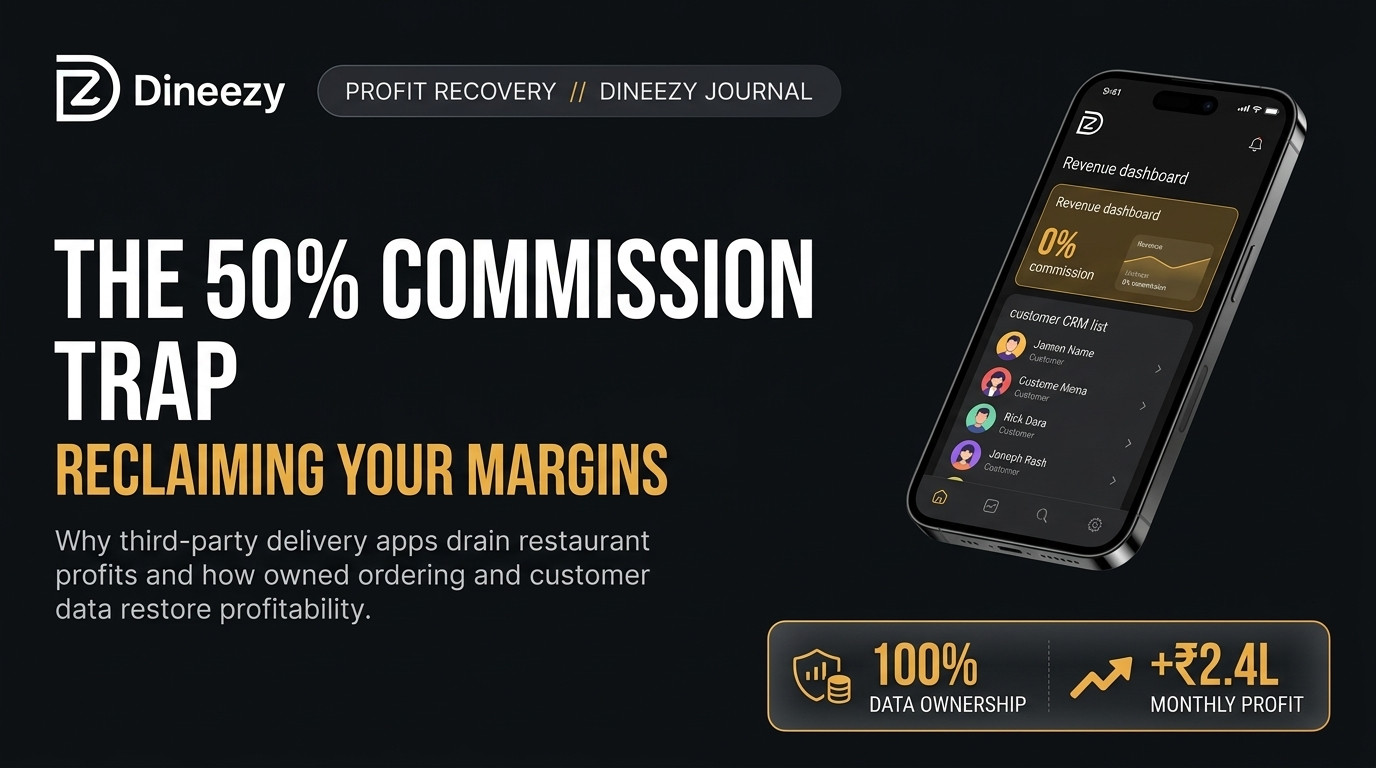
The 50% Commission Trap: How Indian Restaurants Reclaim Lost Margins with Direct Ordering & Owned Customer Data
Think food aggregators only charge 25%? Think again. Discover the full financial audit of hidden commission drains—and learn how Indian restaurateurs use Dineezy direct ordering to protect their bottom line and own their customer data.
Dineezy Team
25 Oct 2026 · 6 min read
On this page10 sections
- The Illusion of High Revenue: A Tale of Two P&L Statements
- Unmasking the True Cost of Third-Party Delivery Apps
- Detailed Financial Comparison: Aggregator vs Dineezy Direct
- The Real Crime: Stolen Customer Data
- The 4-Step Migration Playbook: How to Transition Customers
- Frequently Asked Questions
- Isn't it easier to just accept the 30% commission as a marketing cost?
- How quickly can a restaurant set up Dineezy?
- Do we need special hardware to run Dineezy?
- Take Back Control of Your Restaurant's Future
The Illusion of High Revenue: A Tale of Two P&L Statements
It is the end of the month. A cloud kitchen founder in Indiranagar, Bengaluru, looks at his sales dashboard.
- Gross Food Delivery Sales: ₹12,00,000.
- On paper, business looks booming. The kitchen has been cooking non-stop, packing 80 biryanis, 120 rolls, and 50 curries every evening. Delivery riders are parked three deep outside the kitchen door.
Then the bank payout lands: ₹5,88,000.
Over ₹6,12,000 (51% of gross revenue) has vanished into platform fees, promotional funding, and search ad charges. After paying raw ingredient suppliers (₹3,80,000), kitchen rent (₹90,000), staff salaries (₹1,50,000), and packaging boxes (₹45,000), the founder is operating at a net monthly loss of ₹77,000.
This is not an isolated horror story. It is the lived reality of tens of thousands of restaurant, cafe, and bakery owners across India.
They are caught in the 50% Aggregator Commission Trap.
In 2026, the restaurant industry is drawing a line in the sand. Operators are breaking the cycle by establishing their own Direct-to-Consumer (D2C) Ordering Channels powered by Dineezy.
Unmasking the True Cost of Third-Party Delivery Apps
When an aggregator sales rep pitches a restaurant, they usually quote a base commission rate: "Sir, it is only 22% to 25%."
What they do not disclose in bold font is the cascade of mandatory secondary deductions that quietly multiply that cost:
1. Base Platform Commission (24% to 28%): Charged on the gross bill total before taxes.
2. 18% GST on Commission Fees (4.5% to 5.0%): A tax on the aggregator fee that restaurants cannot claim input tax credit (ITC) on under the 5% restaurant GST regime.
3. Mandatory Co-Funded Discounts (10% to 15%): Aggregators push restaurants to fund vouchers ("Flat ₹100 OFF on orders above ₹299"). If you refuse, your outlet gets buried in algorithmic search results.
4. Sponsored CPC Search Advertising (5% to 8%): To appear on the first screen when a diner searches "pizza" or "biryani", restaurants must spend thousands daily bidding for placement.
5. Customer Cancellation Penalties & Packaging Claims (2% to 3%): Aggregators routinely penalize kitchens for cancellations even when delays are caused by the platform's own riders.
When you total these deductions, the effective commission rate on delivery orders consistently climbs to 48% to 56%.
Detailed Financial Comparison: Aggregator vs Dineezy Direct
Let us look at the hard unit economics of an Indian restaurant generating ₹10,00,000 in monthly delivery orders (average ticket size: ₹500 across 2,000 orders):
| Financial Breakdown | Pure Aggregator Dependency | Dineezy Direct Model + Owned CRM |
|---|---|---|
| Gross Monthly Food Sales | ₹10,00,000 | ₹10,00,000 |
| Base Commission Cut (~26%) | -₹2,60,000 | ₹0.00 Commission Paid |
| 18% GST on Commission | -₹46,800 | ₹0.00 |
| Mandatory App Discount Co-Funding | -₹1,10,000 | -₹40,000 (Targeted direct diner incentives) |
| Sponsored In-App Search Ads | -₹70,000 | ₹0.00 (Organic Instagram & WhatsApp CRM) |
| Delivery Logistics Expense | Covered by platform | -₹90,000 (Flat fee 3PL / In-House Riders) |
| Dineezy Platform Subscription | None | -₹3,499 flat monthly fee |
| Total Channel Operating Costs | -₹4,86,800 (48.7% Drain!) | -₹1,33,499 (13.3% Total Expense) |
| Net Retained Cash to Restaurant | ₹5,13,200 | ₹8,66,501 |
| Monthly Net Profit Improvement | Baseline | +₹3,53,301 PURE CASH EVERY MONTH! |
By transitioning just 50% to 70% of regular customer orders to a direct Dineezy storefront, this single restaurant deposits an additional ₹3.5 Lakhs into their bank account every single month—equivalent to over ₹42 Lakhs in extra annual profit.
The Real Crime: Stolen Customer Data
The financial cut is painful, but the loss of customer ownership is fatal to long-term business survival.
When a customer orders your food on a third-party app:
- You receive a masked phone number that expires after 30 minutes.
- You do not get the diner's name, email, or order history.
- The platform uses your food to acquire that customer, analyzes their eating habits, and then uses push notifications to steer them toward competitor cloud kitchens and their own private-label food brands!
With Dineezy Direct Ordering, the paradigm is reversed:
- 100% Data Ownership: Every phone number, delivery address, lifetime spend, and culinary preference belongs exclusively to your restaurant.
- Direct Communication: You can reach out to your diners whenever you want via automated WhatsApp updates, VIP loyalty tiers, and personalized weekend specials.
- Asset Creation: A restaurant with a private, active database of 10,000 loyal customer phone numbers has real enterprise value; an outlet relying 100% on delivery apps has zero brand equity.
The 4-Step Migration Playbook: How to Transition Customers
You do not need to cut off aggregators overnight. Use them as an expensive top-of-funnel customer acquisition tool, and then systematically migrate repeat diners to your direct channel:
1. The 'Direct VIP' Box Insert: Print a glossy card inside every outbound aggregator bag: "Loved your food? Order directly on our official WhatsApp or web store next time to get Flat 20% OFF + Free Dessert with code DIRECT20. dineezy.in/your-brand".
2. Instagram DM & Reel Automation: Convert social media traffic directly into orders using Dineezy auto-replies. When followers ask about dishes in comments, Dineezy instantly sends your direct ordering link.
3. Google Business Profile Integration: Ensure your verified Google Maps listing has your direct Dineezy ordering link attached to the 'Order Online' button.
4. Gamified Retention & Loyalty: Once a diner orders direct, reward them with Dineezy loyalty coins and digital stamp cards so they never have a reason to order through a third-party app again.
Frequently Asked Questions
Isn't it easier to just accept the 30% commission as a marketing cost?
When delivery accounts for 60% to 80% of your business, a 50% effective deduction is not a marketing cost—it is an existential threat to your business. Surviving on single-digit margins leaves zero room to handle food inflation, rising rents, or seasonal dips.
How quickly can a restaurant set up Dineezy?
Dineezy can be fully configured in less than 48 hours. Our team assists with menu onboarding, delivery zone setup, UPI payment gateway integration, and staff training.
Do we need special hardware to run Dineezy?
No. Dineezy runs seamlessly on existing Windows POS counters, iPads, Android tablets, or standard smartphones that your team already uses.
Take Back Control of Your Restaurant's Future
Your recipes, your kitchen staff, and your passion built your restaurant's reputation. Why should tech monopolies take 50% of the rewards?
Join thousands of profitable Indian restaurants who have broken free from the commission trap.
Deliver hotter food, build lifelong diner relationships, and keep 100% of your profits where they belong: in your business.
Start Your 0% Commission Direct Ordering with Dineezy at dineezy.in/business today.
Dineezy Team
Author at Dineezy