How to Calculate Your Restaurant's Break-Even Point: Formula and Example (2026 Guide)
A practical financial guide for Indian restaurateurs. Learn the break-even formula, separate fixed from variable costs, and establish daily sales targets that ensure profitability.
Dineezy Team
13 Oct 2026 · 6 min read
On this page21 sections
- The Financial Milestone Every Restaurant Must Know
- Understanding Fixed Costs vs. Variable Costs
- 1. Fixed Operating Costs
- 2. Variable Operating Costs
- The Restaurant Break-Even Sales Formula
- Calculating the Contribution Margin Ratio:
- Complete Worked Example in Indian Rupees
- 1. Monthly Fixed Overhead Budget:
- 2. Variable Cost Proportions (as % of Sales):
- 3. Contribution Margin Calculation:
- 4. Monthly Break-Even Revenue:
- Translating Monthly Break-Even into Daily Sales Targets
- Step 1: Daily Revenue Target (Assuming 30 Operating Days)
- Step 2: Translating into Customer Covers
- 3-Scenario Sensitivity Analysis
- Common Mistakes in Restaurant Break-Even Calculations
- Frequently Asked Questions
- How does delivery commission impact my restaurant's break-even point?
- What is the difference between accounting break-even and cash break-even?
- How can digital ordering platforms help restaurants reach break-even faster?
- Turn Financial Targets into Daily Action
The Financial Milestone Every Restaurant Must Know
Before opening your doors or planning expansion, every restaurant owner faces a fundamental question: How much revenue must we generate each month just to avoid losing money?
This figure is your Break-Even Point (BEP).
In the fast-paced restaurant industry, operating without a clear break-even target is like navigating without a compass. Many founders evaluate performance purely by cash balances in their current account, confusing temporary cash inflows from weekend sales with genuine business profitability.
Understanding how to calculate your break-even point allows you to set clear daily sales benchmarks, structure menu pricing safely, and evaluate the financial impact of commercial leases before signing agreements.
Understanding Fixed Costs vs. Variable Costs
To calculate break-even accurately, you must categorize every business expense into either Fixed Costs or Variable Costs:
1. Fixed Operating Costs
Fixed costs remain unchanged regardless of whether your restaurant serves 50 guests or 500 guests in a day:
- Commercial Property Rent & Maintenance Fees
- Permanent Base Staff Salaries & Benefits
- Broadband, Telephone & Software POS Subscriptions
- Commercial Kitchen Equipment Leases
- Municipal Licenses, FSSAI Renewals & Accounting Retainers
- Depreciation & Loan EMI Payments
2. Variable Operating Costs
Variable costs fluctuate directly with transaction and sales volume:
- Raw Food & Beverage Ingredients (Cost of Goods Sold)
- Takeaway Containers, Biodegradable Cutlery & Paper Bags
- Payment Gateway Fees & Credit Card Machine Surcharges (1.5%–2%)
- Third-Party Aggregator Delivery Commissions (22%–32%)
- Variable Gas Cylinder & Electricity Consumption
The Restaurant Break-Even Sales Formula
The standard formula for break-even revenue is:
$$\text{Break-Even Sales (₹)} = \frac{\text{Total Monthly Fixed Costs}}{\text{Contribution Margin Ratio}}$$
Calculating the Contribution Margin Ratio:
First, calculate your Variable Cost Percentage:
$$\text{Variable Cost \%} = \left( \frac{\text{Total Variable Expenses}}{\text{Total Sales}} \right) \times 100$$
Then determine the Contribution Margin Ratio:
$$\text{Contribution Margin Ratio} = 1 - \text{Variable Cost Ratio}$$
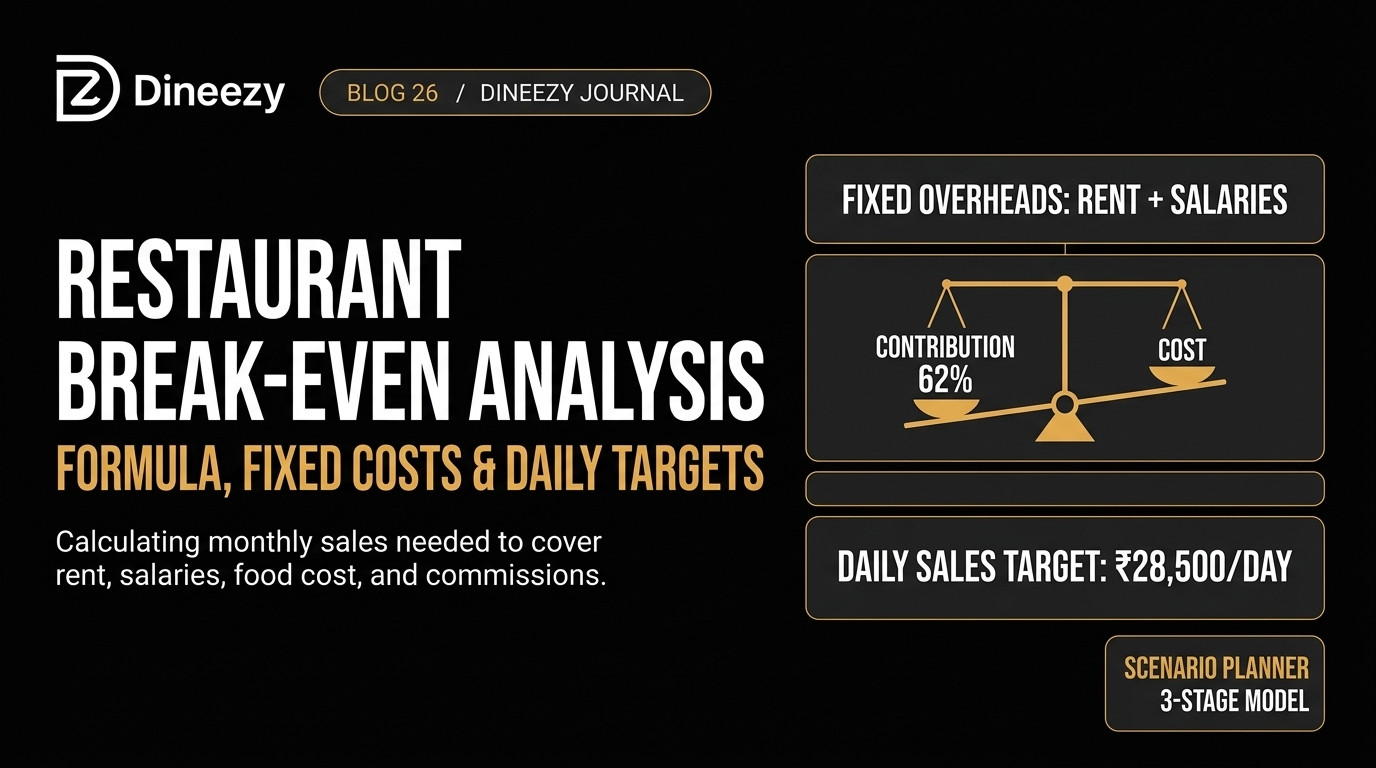
The Contribution Margin represents the portion of each rupee in sales that remains to cover fixed overheads after direct variable costs have been deducted.
Complete Worked Example in Indian Rupees
Let us calculate the break-even sales for a typical 40-seat casual dining restaurant operating in a metro or Tier-1 Indian city.
1. Monthly Fixed Overhead Budget:
- Restaurant Commercial Rent: ₹1,60,000
- Core Staff Salaries (Kitchen + Floor): ₹1,80,000
- Electricity, Water & Utilities Base: ₹35,000
- Software POS, Internet & SaaS: ₹5,000
- Marketing & Local Promotions: ₹20,000
- Legal, Accounting & Maintenance Retainers: ₹10,000
- Total Monthly Fixed Costs: ₹4,10,000
2. Variable Cost Proportions (as % of Sales):
- Raw Food Cost: 32%
- Packaging Materials & Disposables: 3%
- Payment Gateway & EDC Surcharges: 2%
- Blended Commission & Logistics Costs: 5%
- Total Variable Cost Ratio: 42% (or 0.42)
3. Contribution Margin Calculation:
$$\text{Contribution Margin Ratio} = 1 - 0.42 = 0.58\text{ (58\%)}$$
4. Monthly Break-Even Revenue:
$$\text{Break-Even Sales} = \frac{₹4,10,000}{0.58} = ₹7,06,897$$
To cover all operating expenses and achieve zero profit/loss, this restaurant must generate ₹7,06,897 in net monthly sales.
Translating Monthly Break-Even into Daily Sales Targets
A monthly figure of ₹7.07 Lakhs can feel abstract for floor managers running day-to-day operations. Break it down into clear daily operational targets:
Step 1: Daily Revenue Target (Assuming 30 Operating Days)
$$\text{Daily Break-Even Target} = \frac{₹7,06,897}{30} = ₹23,563 / \text{day}$$
Step 2: Translating into Customer Covers
If your restaurant's Average Order Value (AOV) or Average Per Cover (APC) is ₹650 per guest:
$$\text{Daily Covers Needed} = \frac{₹23,563}{₹650} \approx 37 \text{ paying diners per day}$$
For a 40-seat restaurant, serving 37 guests daily requires turning less than 1 full seating per day simply to break even. Any table turned beyond that baseline generates net operating profit.
3-Scenario Sensitivity Analysis
Operating realities change throughout the year. Running conservative, expected, and optimistic scenarios prepares owners for seasonal shifts:
| Scenario Metric | Conservative (Monsoon / Off-Peak) | Expected Normal Month | Optimistic (Festive / Q4 Rush) |
|---|---|---|---|
| Monthly Fixed Costs | ₹4,10,000 | ₹4,10,000 | ₹4,10,000 |
| Food & Variable Cost % | 45% (High wastage, lower volume) | 42% (Standard recipe control) | 38% (High turn, volume discounts) |
| Contribution Margin | 55% (0.55) | 58% (0.58) | 62% (0.62) |
| Required Break-Even Sales | ₹7,45,455 | ₹7,06,897 | ₹6,61,290 |
| Daily Target (30 Days) | ₹24,849 / day | ₹23,563 / day | ₹22,043 / day |
Notice the critical insight: when recipe controls improve contribution margin from 55% to 62%, your required break-even revenue drops by over ₹84,000 per month.
Common Mistakes in Restaurant Break-Even Calculations
1. Ignoring Delivery Aggregator Commission Discrepancies: Dine-in orders have 0% aggregator commission, while Swiggy and Zomato orders lose 25% to 30%. Blending your variable costs without accounting for channel mix distorts your true break-even.
2. Confusing Gross Margin with Contribution Margin: Gross margin only subtracts food ingredients. Contribution margin subtracts all variable costs, including packaging and card swipe fees.
3. Excluding Founder Salaries: Founders often treat their own compensation as optional profit. If you do not include fair compensation for your operational role in fixed overheads, your break-even calculation is artificially low.
4. Treating Taxes as Revenue: GST collected on behalf of the government is not company income. Always calculate break-even using net sales figures excluding GST.
Frequently Asked Questions
How does delivery commission impact my restaurant's break-even point?
Aggregator commissions increase your variable cost percentage. If delivery represents 50% of your sales at a 28% commission, your blended variable costs rise, requiring higher overall monthly sales to cover the same fixed rent and salaries.
What is the difference between accounting break-even and cash break-even?
Accounting break-even includes non-cash expenses like equipment depreciation. Cash break-even looks strictly at actual bank account inflows and outflows, which is useful for monitoring runway during the first six months of launch.
How can digital ordering platforms help restaurants reach break-even faster?
By building direct, zero-commission customer ordering channels with solutions like Dineezy, restaurants reduce commission leakage and preserve higher contribution margins on every order.
Turn Financial Targets into Daily Action
Knowing your break-even number shifts restaurant management from anxiety to structured strategy. Track your daily numbers against your baseline, monitor weekly ingredient variances, and keep overheads lean.
Explore Dineezy's Modern Restaurant Tech Suite at dineezy.in/business to streamline billing, accelerate table turn times, and protect bottom-line profitability.
Dineezy Team
Author at Dineezy