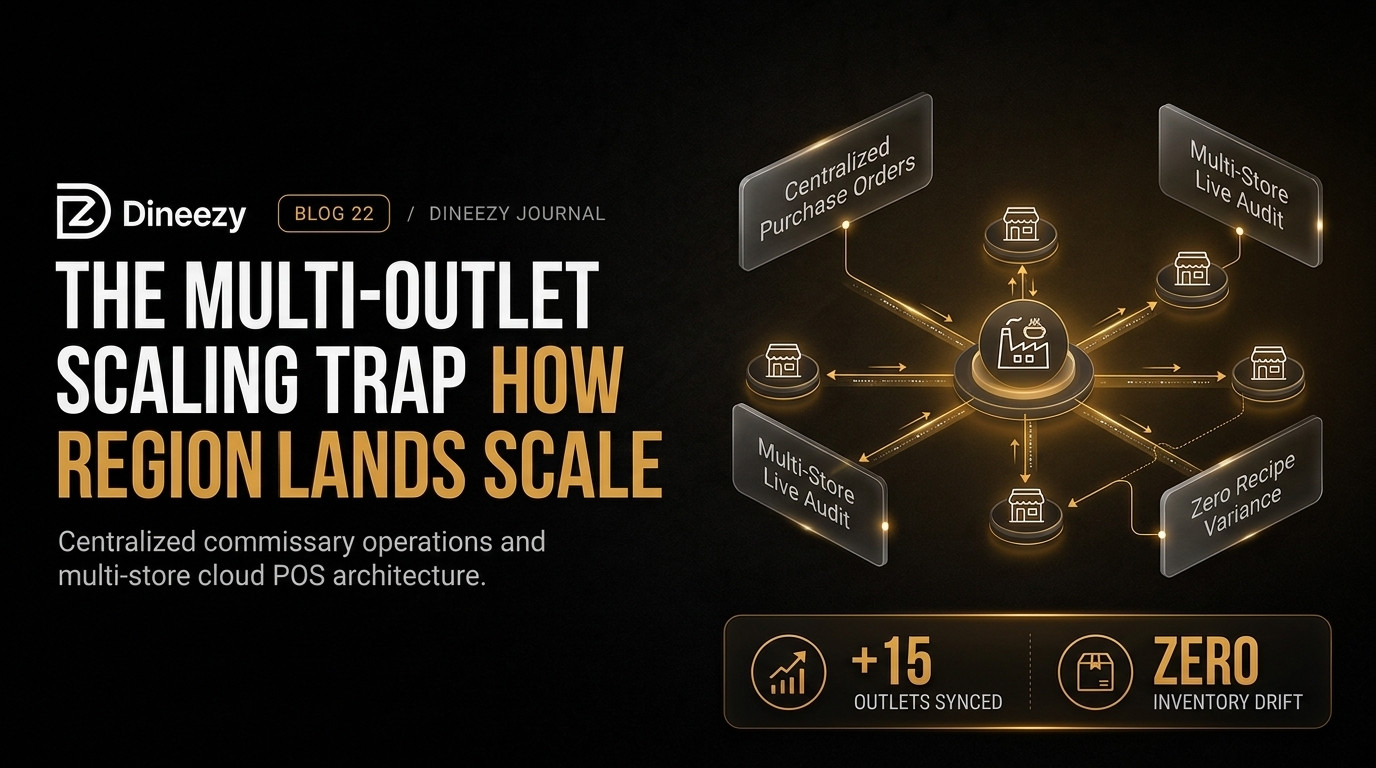
The Multi-Outlet Scaling Trap: How Regional Indian Food Brands Expand to 15 Outlets Without Chaos
The 3-Outlet Mirage An ambitious culinary founder builds two thriving casual dining restaurants in Bengaluru or Mumbai. Both outlets operate at full capacity,…
Dineezy Team
3 Oct 2026 · 5 min read
On this page15 sections
- The 3-Outlet Mirage
- The Central Commissary Architecture: Decoupling Prep from Assembly
- 1. The Central Commissary Kitchen (The Mother Hub)
- 2. The Retail Outlets (The Assembly Nodes)
- Decentralized Spreadsheets vs. Centralized Multi-Store Cloud POS
- Three Operational Controls Essential for Multi-Branch Growth
- 1. The Digital Store Indent Engine
- 2. Centralized Master Menu Control
- 3. Cross-Store Fraud Detection and Anomaly Telemetry
- The Multi-Unit Expansion Checklist
- Frequently Asked Questions
- At what stage should an Indian restaurant brand build a central commissary?
- How does a multi-outlet POS handle local regional taxes and price variations?
- Can store managers run offline if the internet drops at a branch?
- The Operational Bottom Line
The 3-Outlet Mirage
An ambitious culinary founder builds two thriving casual dining restaurants in Bengaluru or Mumbai. Both outlets operate at full capacity, generate positive cash flow, and maintain high ratings across social media.
Encouraged by success, the brand signs leases for four new locations, raises expansion capital, and announces plans to reach 15 outlets across two states within eighteen months.
Nine months into the expansion, cracks appear across the operation:
- The signature biryani in the Indiranagar outlet tastes completely different from the Koramangala and Whitefield branches.
- Store managers place decentralized ingredient purchase orders with local suppliers, creating a 22% variance in raw meat and dairy procurement costs.
- Cash reconciliation discrepancies escalate because each outlet uses isolated legacy POS terminals with local database storage.
- The executive chef spends sixty hours a week driving between kitchen locations trying to police portion sizes and prep standards.
This operational breakdown is the multi-outlet scaling trap. Running two restaurants relies on personal founder oversight. Running fifteen locations requires a centralized commissary kitchen and multi-store cloud POS architecture.
---The Central Commissary Architecture: Decoupling Prep from Assembly
Traditional single-unit restaurants cook everything from scratch in their individual kitchen backrooms. When scaling to multiple branches, replicating full cooking lines at every retail location inflates equipment costs, kitchen square footage, and staffing overhead.
Regional restaurant brands that scale successfully decouple primary prep from final store assembly:
1. The Central Commissary Kitchen (The Mother Hub)
The brand establishes a single industrial kitchen facility in a low-rent industrial corridor. High-skill culinary staff operate here under strict manufacturing protocols:
- Raw ingredient butchery, marination, and precision vacuum packaging
- Master curry gravy batch production (Makhani, Korma, Yellow Gravy) in 100-liter steam kettles
- Centralized quality control, brix testing, and microbiological shelf-life validation
- Bulk procurement directly from agricultural producers, cutting raw material costs by 18% to 25%
2. The Retail Outlets (The Assembly Nodes)
Branch stores operate compact kitchens requiring half the footprint and equipment. Line cooks assemble, grill, and garnish pre-portioned packs delivered daily from the commissary.
Food consistency remains identical whether a guest dines in Pune, Mumbai, or Thane, because the base sauce was prepped in the exact same kettle under standard thermal controls.
---Decentralized Spreadsheets vs. Centralized Multi-Store Cloud POS
| Operational Dimension | Legacy Standalone Outlets | Dineezy Multi-Outlet Cloud Architecture |
|---|---|---|
| Menu Updates & Pricing | Manager updates each POS machine manually; price errors common | 1-click global menu sync across all 15 stores simultaneously |
| Procurement & Indents | Branch managers call vendors; unauthorized cash purchases | Digital store indents routed to central commissary warehouse |
| Recipe Consistency | Line cook memory; taste varies across locations | Central commissary batches enforce standardized portion yield |
| Daily Cash & Sales Audit | Accountants collect CSV files via email; 5-day audit lag | Real-time cross-store revenue, tax, and void telemetry |
| Role-Based Staff Permissions | Local admin passwords shared on sticky notes | Enterprise RBAC with OTP manager authorization on voids |
Three Operational Controls Essential for Multi-Branch Growth
1. The Digital Store Indent Engine
Store managers should never negotiate purchase orders with third-party vendors. In Dineezy, each branch manager reviews their daily theoretical stock and submits an automated Store Indent to the central commissary by 11:00 PM.
The commissary warehouse aggregates indents from all 15 outlets, compiles morning dispatch manifests, and generates route-optimized delivery logs. Unauthorized off-book ingredient purchases drop to zero.
2. Centralized Master Menu Control
Introducing a seasonal promotion or updating tax rates across fifteen branches cannot depend on store staff remembering to update settings. Centralized cloud control allows brand headquarters to push menu additions, price adjustments, and promotional combos globally or by regional clusters in seconds.
3. Cross-Store Fraud Detection and Anomaly Telemetry
When an operator runs ten outlets, identifying bill manipulation requires automated telemetry. Dineezy benchmarks store performance metrics against the network average:
- If Branch 4 records a 9% bill void rate while the network average hovers at 1.8%, the system alerts the operations director immediately.
- If Branch 7 registers a 30% higher consumption of cooking oil per biryani sold, the audit engine flags portion drift before monthly books close.
The Multi-Unit Expansion Checklist
- [ ] Audit Kitchen Footprint: Can you shrink branch kitchen areas by shifting sauce prep and vegetable butchery to a central hub?
- [ ] Standardize Master Recipes: Build digital Bill of Materials (BOM) for every item with exact gram weights and packaging specifications.
- [ ] Enforce Commissary Indents: Ban local store cash procurement; route all store stock replenishment through central dispatch requests.
- [ ] Unify Cloud POS: Migrate legacy offline terminals to a unified cloud database with real-time multi-branch reporting.
- [ ] Lock Down Cash Controls: Enforce multi-tier manager authorizations for bill cancellations, discounts, and complimentary punches.
Frequently Asked Questions
At what stage should an Indian restaurant brand build a central commissary?
Most successful operators build a dedicated commissary kitchen when opening their third or fourth location. At this threshold, bulk raw ingredient purchasing savings offset commissary facility rent while protecting brand consistency.
How does a multi-outlet POS handle local regional taxes and price variations?
Dineezy allows regional price tiers and location-specific menu overrides under a single master brand account. You can maintain higher menu pricing at airport or high-rent metro branches while synchronizing standard recipes and inventory rules across all stores.
Can store managers run offline if the internet drops at a branch?
Yes. Dineezy features local offline fallback capabilities, ensuring order punching, KOT printing, and UPI billing continue uninterrupted during internet outages, synchronizing transactions back to the central cloud automatically once connectivity restores.
---The Operational Bottom Line
Expanding from three restaurants to fifteen outlets cannot be accomplished through grit and long hours alone. Human oversight does not scale across municipal borders.
Build disciplined commissary kitchens, connect your branches to a unified cloud POS infrastructure, and protect your margins as your brand expands.
---Ready to scale your restaurant brand across multiple outlets with centralized cloud control?
Discover Dineezy Enterprise Multi-Store POS, Commissary Inventory & Franchise Intelligence
Published by Atharv K. | F&B Systems Explorer | Dineezy F&B Intelligence
Dineezy Team
Author at Dineezy