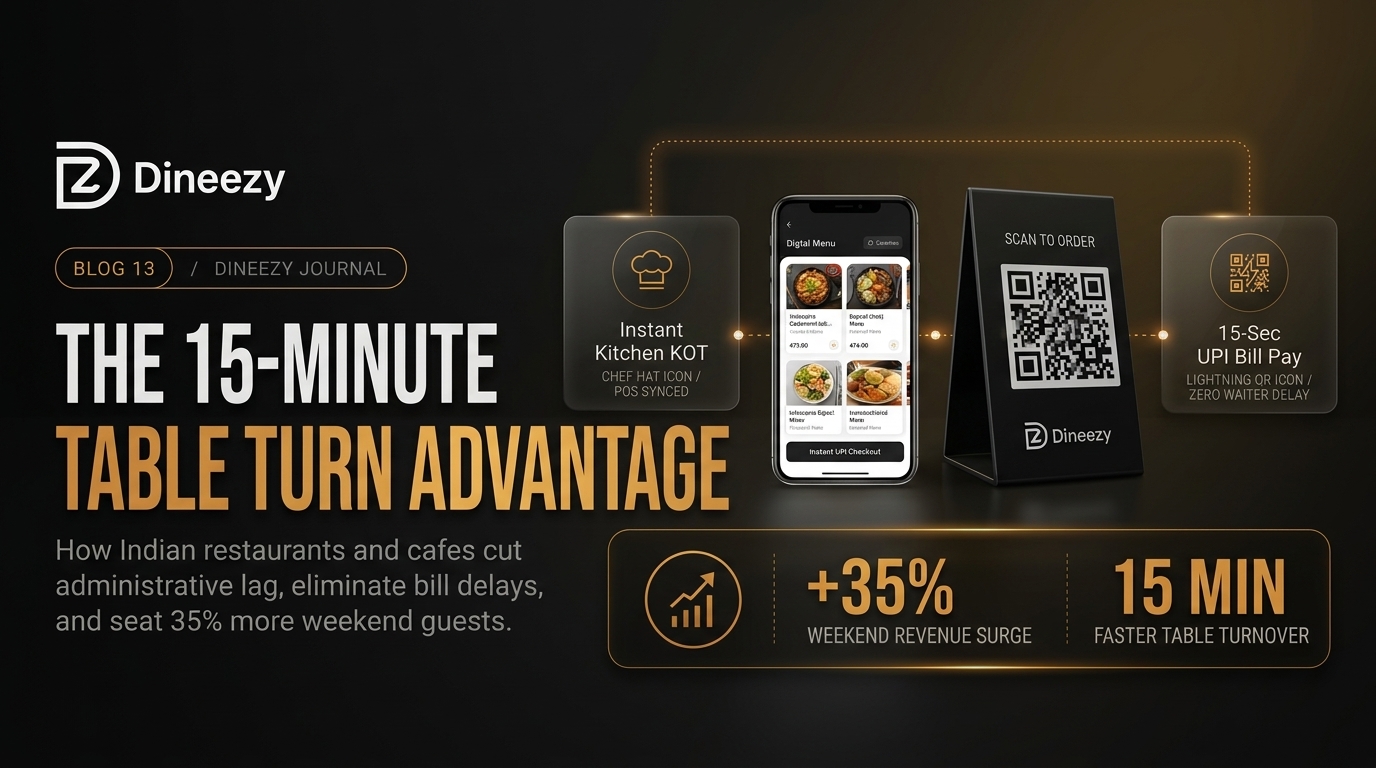
The 15-Minute Table Turn Advantage: How Indian Restaurants Serve 30% More Diners on Peak Weekends
Introduction: The Friday Night Bottleneck in Every Indian Dining Room It is 8:45 PM on a Saturday evening in Pune, Hyderabad, or Bengaluru. Your restaurant…
Dineezy Team
22 Sept 2026 · 8 min read
On this page14 sections
- Introduction: The Friday Night Bottleneck in Every Indian Dining Room
- The Revenue Math: What 15 Minutes Means for Your Monthly Profit
- Comparison: Traditional Waiter Turn vs. Dineezy Hybrid QR Turn
- The 4 Bottlenecks That Slow Down Table Turns (And How to Fix Them)
- 1. The Menu Bottleneck
- 2. The Kitchen Order Routing Delay
- 3. The Re-order Friction Trap
- 4. The Payment Settlement Drag
- Actionable Floor Checklist for Peak Weekend Shifts
- Frequently Asked Questions
- Will QR code ordering make our dining experience feel cold or impersonal?
- What if elderly customers or non-tech-savvy diners prefer ordering from a person?
- How does faster table turnaround affect kitchen stress during peak hours?
- The Operational Takeaway
Introduction: The Friday Night Bottleneck in Every Indian Dining Room
It is 8:45 PM on a Saturday evening in Pune, Hyderabad, or Bengaluru. Your restaurant lobby has fifteen groups waiting on the sofa benches. Outside your main door, couples and families check their queue tokens every three minutes.
Meanwhile, inside your dining hall, Table 6 finished their main course ten minutes ago. Their empty plates sit cleared. They want their bill so they can leave. Table 11 sat down seven minutes ago, looking around the room trying to catch a waiter's eye to place their food order.
Between your hungry waiting guests and your seated diners, a quiet friction point costs your restaurant money every evening: unnecessary table turnover friction.
In most Indian casual dining restaurants and cafes, an average table sits occupied for 70 to 80 minutes. Yet the actual time guests spend eating and drinking is only 45 to 50 minutes. The remaining 25 to 30 minutes vanish into dead operational time:
- Waiting four minutes for a server to bring physical paper menus.
- Waiting six minutes for a server to return and write down the order on a pad.
- Waiting five minutes for the captain to walk to the central billing terminal and punch the Kitchen Order Ticket (KOT).
- Waiting eight minutes at the end of the meal to request the check, receive a printed bill folder, scan a UPI QR code, or wait for a handheld card machine.
Shaving just fifteen minutes off that dead time across peak lunch and dinner hours allows your floor team to seat an entire extra round of guests without adding a single extra chair or expanding your kitchen footprint.
---The Revenue Math: What 15 Minutes Means for Your Monthly Profit
Let us look at the financial impact on a typical 20-table casual dining restaurant in an Indian metro:
- Total Tables: 20 tables (average 4 seats per table)
- Average Order Value (AOV): ₹1,200 per table
- Peak Weekend Window: Friday to Sunday dinner (7:30 PM to 10:30 PM = 3 hours)
- Traditional Turn Time: 75 minutes (roughly 1.3 turns per table over 3 hours = 26 total bills settled)
- Optimized Turn Time: 55 minutes (roughly 2.1 turns per table over 3 hours = 42 total bills settled)
By shortening turn time from 75 minutes to 55 minutes during peak rush, the floor accommodates 16 additional table sittings per weekend dinner.
16 tables multiplied by ₹1,200 average order value equals ₹19,200 in additional revenue per peak night. Over twelve weekend shifts in a month, that single operational change adds ₹2,30,400 in high-margin dine-in revenue.
Because your fixed overheads (rent, air conditioning, base kitchen staffing) remain identical, nearly 65% of that additional revenue drops directly to your net operating profit.
---Comparison: Traditional Waiter Turn vs. Dineezy Hybrid QR Turn
| Operational Step | Traditional Waiter Workflow | Dineezy Hybrid QR Workflow |
|---|---|---|
| Menu Presentation | 3 to 5 minutes waiting for physical menus to become free | Instant. Guests scan the tabletop QR code with their own phone camera |
| Order Placement | 5 to 8 minutes waiting for waiter to record items manually | Guests browse high-res photos and submit orders directly from table |
| KOT Kitchen Dispatch | 2 to 4 minutes while captain walks to central terminal | 12 seconds. Order routes automatically to kitchen display screens |
| Mid-Meal Re-ordering | Guests repeatedly wave hands for extra rotis, drinks, or desserts | 1-tap re-order from phone; instant KOT generation |
| Bill Request & Settlement | 7 to 10 minutes (print bill, deliver folder, card swipe/cash change) | Instant digital check on phone with 1-tap UPI payment settlement |
| Total Cycle Time | 72 to 85 minutes per table | 50 to 58 minutes per table |
The 4 Bottlenecks That Slow Down Table Turns (And How to Fix Them)
1. The Menu Bottleneck
On busy Friday and Saturday nights, paper menus become a physical bottleneck. If your restaurant has 25 tables but only 15 printed menus in good condition, guests at newly seated tables sit empty-handed while staff search for available copies.
The Operational Fix: Place durable, high-finish tabletop QR codes connected to Dineezy. As soon as guests sit, they scan the standee with their phone camera. Within two seconds, your entire live menu loads with crisp dish photography, dietary filters (Jain, Vegan, Gluten-Free), and spice level indicators. Seated guests begin browsing before the server finishes pouring water glasses.
2. The Kitchen Order Routing Delay
In traditional setups, a waiter writes orders on a paper pad using shorthand abbreviations. During peak rush, the waiter takes orders from Table 4, Table 7, and Table 9 before walking back to the single POS billing station. Two other servers are already standing in line waiting to punch their slips.
By the time Table 4's order actually prints in the kitchen, twelve minutes have elapsed since the customer decided what to eat.
The Operational Fix: Implement direct digital KOT dispatch. When diners submit orders via Dineezy or when a captain punches items on a handheld mobile POS, the order instantly splits across kitchen stations. Starters route to the tandoor printer, drinks route to the bar display, and mains route to the curry station within seconds. Food preparation starts immediately.
3. The Re-order Friction Trap
Table turnover slows down noticeably during mid-meal re-orders. A family realizes they need two more butter naans or another round of beverages. Getting a busy waiter's attention across a packed dining room takes three to five minutes.
Because the kitchen takes another seven minutes to prepare the bread, the table sits idle between courses, extending their total stay by ten to twelve minutes without generating significant incremental spend.
The Operational Fix: Allow self-reordering directly through the active table session. Diners tap two buttons on their phone screen to add drinks or bread. The kitchen receives the ticket immediately, keeping the meal flowing smoothly without awkward waiting periods.
4. The Payment Settlement Drag
The final ten minutes of a dining experience are often the most frustrating for both customer and operator. Guests are ready to leave, but they must wave down a server, wait for the bill to be printed from the front counter, inspect the slip, hand over a card or cash, and wait for the transaction to clear.
The Operational Fix: WhatsApp and QR digital bill settlement. Guests view their live running bill on their mobile device at any moment. When finished, they tap Pay via UPI, complete the transaction in four seconds through PhonePe, Google Pay, or Paytm, and receive an instant digital receipt on WhatsApp. The table status automatically switches to vacant on the manager's POS dashboard, alerting housekeeping staff to sanitize the table for the next waiting party.
---Actionable Floor Checklist for Peak Weekend Shifts
- [ ] Verify Table QR Standees: Check that table QR acrylic stands are clean, firmly positioned, and mapped to the correct table numbers in your POS system.
- [ ] Enable Out-of-Stock Item Toggles: Mark sold-out dishes as unavailable on your digital menu before dinner service starts to avoid kitchen cancellations.
- [ ] Position Bussing Stations Strategically: Ensure bussing trays and cleaning supplies are positioned near dining zones so cleared tables are wiped within 90 seconds.
- [ ] Train Staff as Hospitality Guides: Transition waiters from mechanical order-takers to hospitality hosts who welcome guests, explain chef specialties, and ensure drinks arrive promptly.
- [ ] Enable WhatsApp Receipt Dispatch: Configure digital invoice dispatch so guests settle payments without waiting for paper printouts.
Frequently Asked Questions
Will QR code ordering make our dining experience feel cold or impersonal?
No. When technology handles repetitive mechanical steps like writing down dish codes and processing card slips, your service staff spend more time welcoming guests, answering ingredient questions, and serving food fresh from the kitchen. Guests receive faster service without feeling rushed.
What if elderly customers or non-tech-savvy diners prefer ordering from a person?
A resilient dining room uses a hybrid model. Dineezy supports both customer self-ordering via QR code and handheld captain ordering on mobile POS tablets. If a party prefers traditional interaction, a waiter takes their order directly while tech-savvy tables order on their phones.
How does faster table turnaround affect kitchen stress during peak hours?
Digital KOT routing actually reduces kitchen chaos. Instead of five paper tickets arriving in a sudden clump when a waiter finally reaches the POS terminal, orders arrive continuously in steady 12-second intervals, smoothing the preparation curve for kitchen staff.
---The Operational Takeaway
Turning tables faster is not about rushing diners out the door. It is about removing the friction that makes guests wait when they are hungry, and wait again when they are ready to leave.
When you eliminate paper menu shortages, KOT queues, and billing delays, your dining room runs smoothly, your staff handle peak rush with ease, and your restaurant seats 30% more covers every weekend.
---Ready to eliminate table bottlenecks and boost your weekend restaurant revenue?
Explore Dineezy Table QR Ordering, Mobile KOT & High-Speed POS Intelligence
Published by Atharv K. | F&B Systems Explorer | Dineezy F&B Intelligence
Dineezy Team
Author at Dineezy