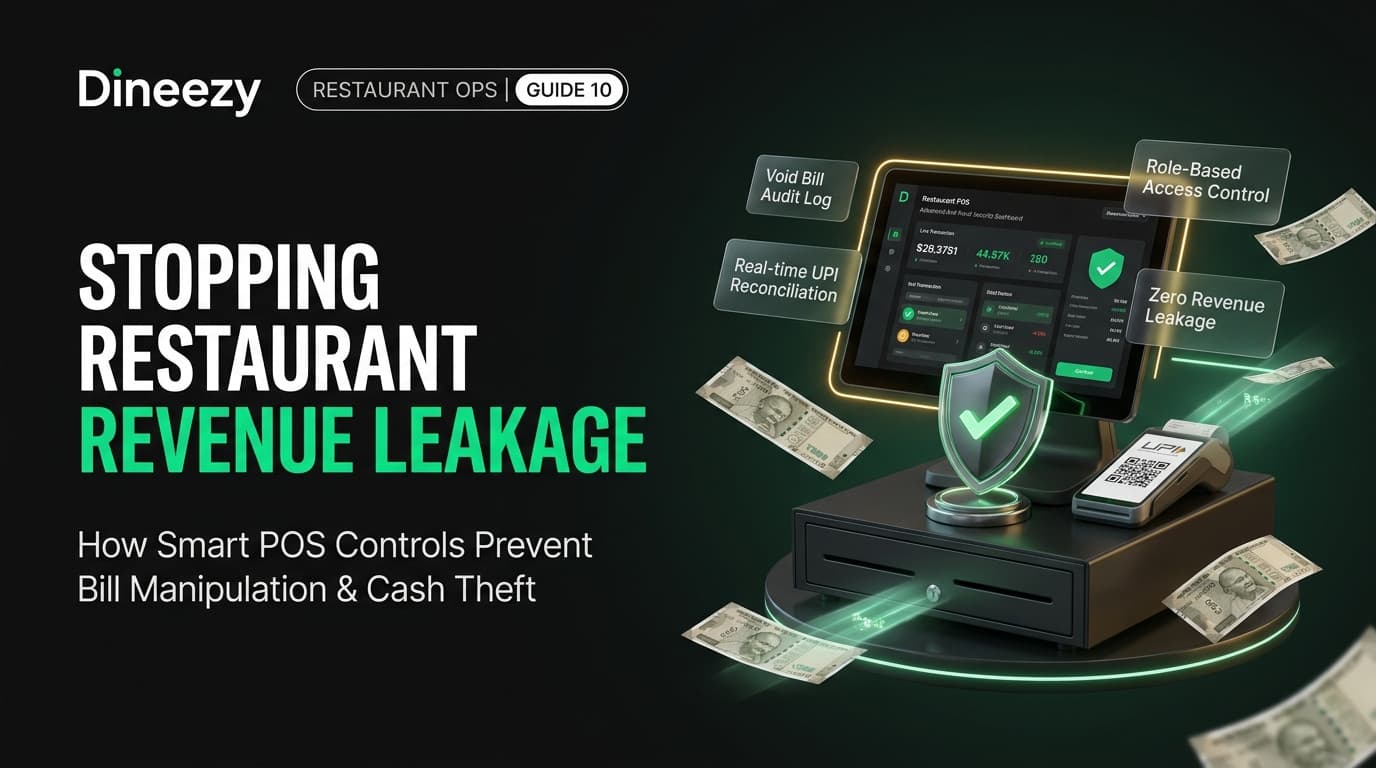
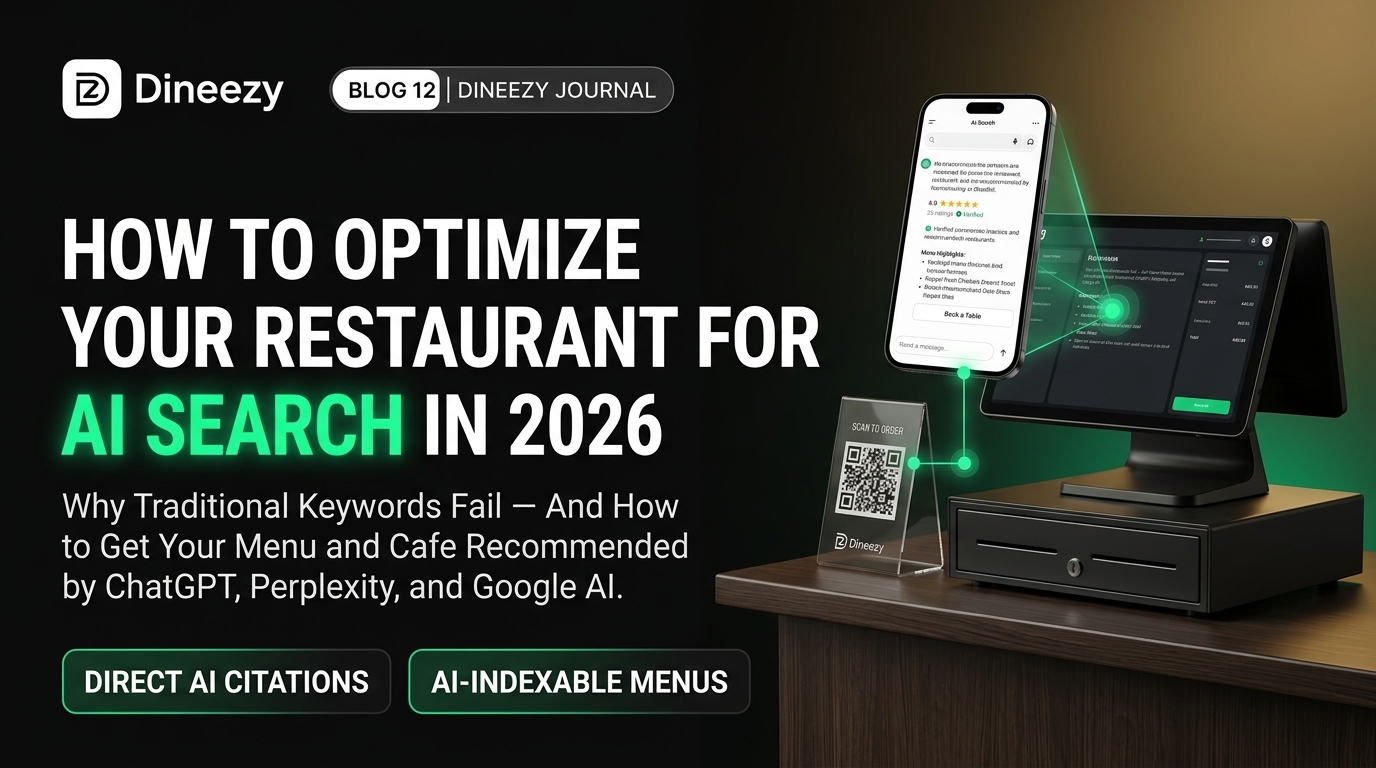
How to Optimize Your Restaurant for AI Search in 2026: Why Traditional Keywords Fail and How to Get Your Menu Recommended by ChatGPT, Perplexity, and Google AI
Introduction: The Saturday Evening Search That Changed Forever It is 7:30 PM on a Friday evening in Bengaluru, Delhi, or Mumbai. A group of four friends is…
Dineezy Team
13 Sept 2026 · 8 min read
On this page16 sections
- Introduction: The Saturday Evening Search That Changed Forever
- The Death of Keyword Stuffing in Food Search
- Comparison: Traditional Food SEO vs. Restaurant AI Search (GEO)
- The 5 Pillars to Make Your Restaurant Rank in AI Search
- 1. Free Your Menu from PDF Traps
- 2. The Answer-First Description Strategy
- 3. Build Digital Consensus Across Off-Page Channels
- 4. Provide Direct, Zero-Commission Action Links
- 5. Keep Real-Time Operational Freshness
- The 7-Day Restaurant AI Search Action Plan
- Frequently Asked Questions
- What is Generative Engine Optimization (GEO) for restaurants?
- Will AI search replace food delivery aggregators like Swiggy and Zomato?
- Do I need an expensive agency to optimize my restaurant for AI search?
- How quickly do AI search engines pick up changes to our restaurant menu?
- The Bottom Line
Introduction: The Saturday Evening Search That Changed Forever
It is 7:30 PM on a Friday evening in Bengaluru, Delhi, or Mumbai. A group of four friends is trying to pick a dinner spot.
Two years ago, they would have opened Google or Zomato, typed "best Italian restaurant near me," and scrolled through twenty ads and sponsored listings.
Today, they do something completely different. They open ChatGPT Search or Perplexity on their phone and ask:
"Find us a lively casual Italian cafe in Indiranagar with good outdoor seating, sourdough pizza, and craft mocktails. What are their top three dishes, and what is the typical bill for two?"
Within four seconds, the AI engine scans dozens of food reviews, menu photos, local directories, and social posts. It gives a single, confident recommendation:
"Here are the top two cafes matching your exact preferences: Cafe Milano and Bella Cucina. At Cafe Milano, diners consistently praise the Truffle Burrata Pizza and Peach Iced Tea, with an average spend of ₹1,400 for two. You can reserve a table or view their live menu directly..."
Notice what just happened. The diners never saw ten blue search links. They never scrolled through sponsored banner ads.
They received a direct, conversational recommendation with two links pointing to the restaurants the AI trusted most.
If your restaurant is the one cited by the AI, you get four high-paying diners walking through your door before your competitors even know a search happened.
If your restaurant is invisible to AI models, you do not just lose rank. You disappear from the consideration list completely.
This is Generative Engine Optimization (GEO) for restaurants. In this practical guide, we explain how AI search engines evaluate dining spots, why traditional keyword tricks no longer work, and how Indian restaurants and cafes can make their menus, reviews, and direct ordering links the top recommendation in 2026.
---The Death of Keyword Stuffing in Food Search
For twenty years, traditional search engines worked like simple keyword indexers. If your website repeatedly mentioned "best butter chicken in Connaught Place," search engines assumed your page was relevant.
AI search engines do not count words. They read and reason like food critics and local concierges.
When a hungry diner asks an AI assistant for a recommendation, the model evaluates four critical trust factors:
- Specific Factual Consensus: Does the internet agree on what your restaurant actually serves and what you do best? If your menu says one thing but reviews say another, the AI loses confidence.
- Machine-Readable Menu Structure: Can the AI crawler read your dishes, ingredient tags, prices, and spice levels cleanly, or is your menu trapped inside an unreadable PDF or a blurry Instagram story?
- Authentic Community Sentiment: What are real diners saying on Google Reviews, Reddit food threads, and food blogs? AI engines weigh honest guest experiences far more than self-promotional marketing copy.
- Direct Digital Action Paths: Can the AI give the diner a direct link to view live tables, place an order, or check out via UPI without forcing them to install a clunky app?
Comparison: Traditional Food SEO vs. Restaurant AI Search (GEO)
| Search Factor | Traditional SEO (2018–2023) | AI Search Optimization (GEO 2026) |
|---|---|---|
| How Diners Search | Short 2-3 word phrases ("cafe bandra") | Conversational, multi-condition questions with specific dietary and vibe preferences |
| Search Result | Ten blue links dominated by aggregators and paid ads | A single synthesized recommendation citing 2 or 3 verified restaurants |
| Ranking Trigger | Keyword repetition and backlink counts | Factual clarity, high review consensus, and structured menu data |
| Menu Visibility | Static PDF uploads or photos on aggregator apps | Crawlable digital menus with real-time dish pricing and dietary tags |
| Customer Path | Click link -> scroll aggregator -> pay 25% platform markup | Direct AI recommendation -> 1-tap table booking or direct ordering link |
The 5 Pillars to Make Your Restaurant Rank in AI Search
1. Free Your Menu from PDF Traps
The single biggest mistake restaurants make is uploading their menu as a scanned PDF or a multi-image carousel on social media.
AI crawlers struggle to extract accurate prices, dietary tags, and dish descriptions from blurry scanned images. When an AI cannot reliably verify your current pricing, it simply skips your restaurant and recommends a competitor whose menu is crisp and crawlable.
The Fix: Use modern, web-based digital menus (such as Dineezy's dynamic menu system) where every dish, ingredient note, portion size, and price is rendered in clean, readable text on your public web page.
2. The Answer-First Description Strategy
When diners ask AI models about signature dishes or dietary options, the AI looks for unambiguous, factual answers.
Instead of poetic, vague descriptions like "A heavenly symphony of local spices," provide clear, informative details:
"Slow-cooked 18-hour Dal Makhani finished with organic white butter and served with clay-oven garlic naan. Mildly spiced, gluten-sensitive option available upon request."
When an AI is asked "Where can I find mild, gluten-sensitive North Indian food in Koramangala?", it immediately identifies your Dal Makhani as an exact factual match.
3. Build Digital Consensus Across Off-Page Channels
AI models are trained to avoid hallucinating recommendations. To ensure they don't send diners to a disappointing venue, they cross-reference multiple independent platforms.
If your Google Business profile, TripAdvisor listing, Instagram bio, and local news mentions all agree on your opening hours, exact address, cuisine specializations, and price tier, the AI treats your venue as an established authority.
Encourage satisfied diners to mention specific signature dishes in their reviews. When thirty different reviews praise your "Wood-Fired Pesto Gnocchi," the AI stores that dish as an undeniable verified specialty.
4. Provide Direct, Zero-Commission Action Links
When ChatGPT Search or Perplexity recommends your restaurant, it includes source links for users to take immediate action.
If your only online presence is locked inside third-party aggregator apps, you lose 25% to 30% of every order in commissions, and you never capture the customer's contact details.
By providing direct links to your branded Dineezy digital ordering and table-booking page, the AI points diners directly to your own zero-commission checkout. You keep 100% of your margins and build direct customer loyalty.
5. Keep Real-Time Operational Freshness
Nothing damages your AI search visibility faster than outdated information. If an AI recommends your cafe for Sunday brunch, but the customer arrives to find your doors closed, that negative feedback ripples across the web.
Ensure your operational hours, holiday timings, and seasonal menu changes are instantly updated across your website and connected POS systems.
---The 7-Day Restaurant AI Search Action Plan
- [ ] Audit Your Online Menu: Check if your food menu is hosted as an unreadable PDF or image. Replace it with a mobile-friendly, crawlable digital menu.
- [ ] Add Dietary and Ingredient Tags: Clearly mark dishes with tags like Jain, Vegan, Keto, Nut-Free, or Chef's Special so AI models can match specific diner questions.
- [ ] Update Business Information Uniformity: Verify that your restaurant name, address, phone number, and operating hours are 100% identical across your website, Google Business, and social profiles.
- [ ] Highlight 3 to 5 Hero Dishes: Write clear, 2-sentence factual descriptions for your bestselling items with pricing and prep styles.
- [ ] Implement Direct Table QR & Online Ordering: Deploy Dineezy to offer instant QR ordering and direct web checkout that AI engines can link to directly.
- [ ] Nurture Dish-Specific Reviews: Ask loyal regulars to mention their favorite dishes by name when leaving feedback on Google Reviews.
- [ ] Test Your Restaurant in AI Search: Open ChatGPT Search or Perplexity and ask for restaurant recommendations in your neighborhood with your specialty. Review the answer to see if your cafe is cited.
Frequently Asked Questions
What is Generative Engine Optimization (GEO) for restaurants?
GEO is the process of optimizing your restaurant's digital presence, web menu, and reviews so conversational AI search engines (like ChatGPT Search, Perplexity, and Google AI Overviews) recognize your venue and recommend it as the top answer when diners ask for dining suggestions.
Will AI search replace food delivery aggregators like Swiggy and Zomato?
Aggregators remain popular for convenience, but high-ticket diners and weekend foodies are increasingly turning to conversational AI assistants for authentic, unbiased recommendations. Once an AI recommends a spot, diners prefer ordering directly from the restaurant or booking a table to avoid inflated aggregator markups.
Do I need an expensive agency to optimize my restaurant for AI search?
No. The most effective steps cost zero extra budget: replacing PDF menus with clean digital menus, writing factual dish descriptions, maintaining consistent operating hours, and setting up a modern POS with direct ordering links.
How quickly do AI search engines pick up changes to our restaurant menu?
Because modern AI engines crawl the live web in real time, switching to an indexable digital menu with clear dish tags can begin influencing conversational AI recommendations within two to three weeks.
---The Bottom Line
The era of diners scrolling through twenty random search links on Google is ending.
In 2026, the restaurants that fill their dining rooms will be those that make it effortless for AI search models to read their menus, verify their food quality, and direct diners to their tables.
Free your menu from PDF traps, build undeniable local consensus, and give diners a direct, zero-commission way to experience your food.
---Ready to turn your restaurant into an AI-ready, high-profit dining destination?
Discover Dineezy's Digital Menus, QR Ordering & Direct Restaurant POS Intelligence
Published by Atharv K. | F&B Systems Explorer | Dineezy F&B Intelligence
Dineezy Team
Author at Dineezy